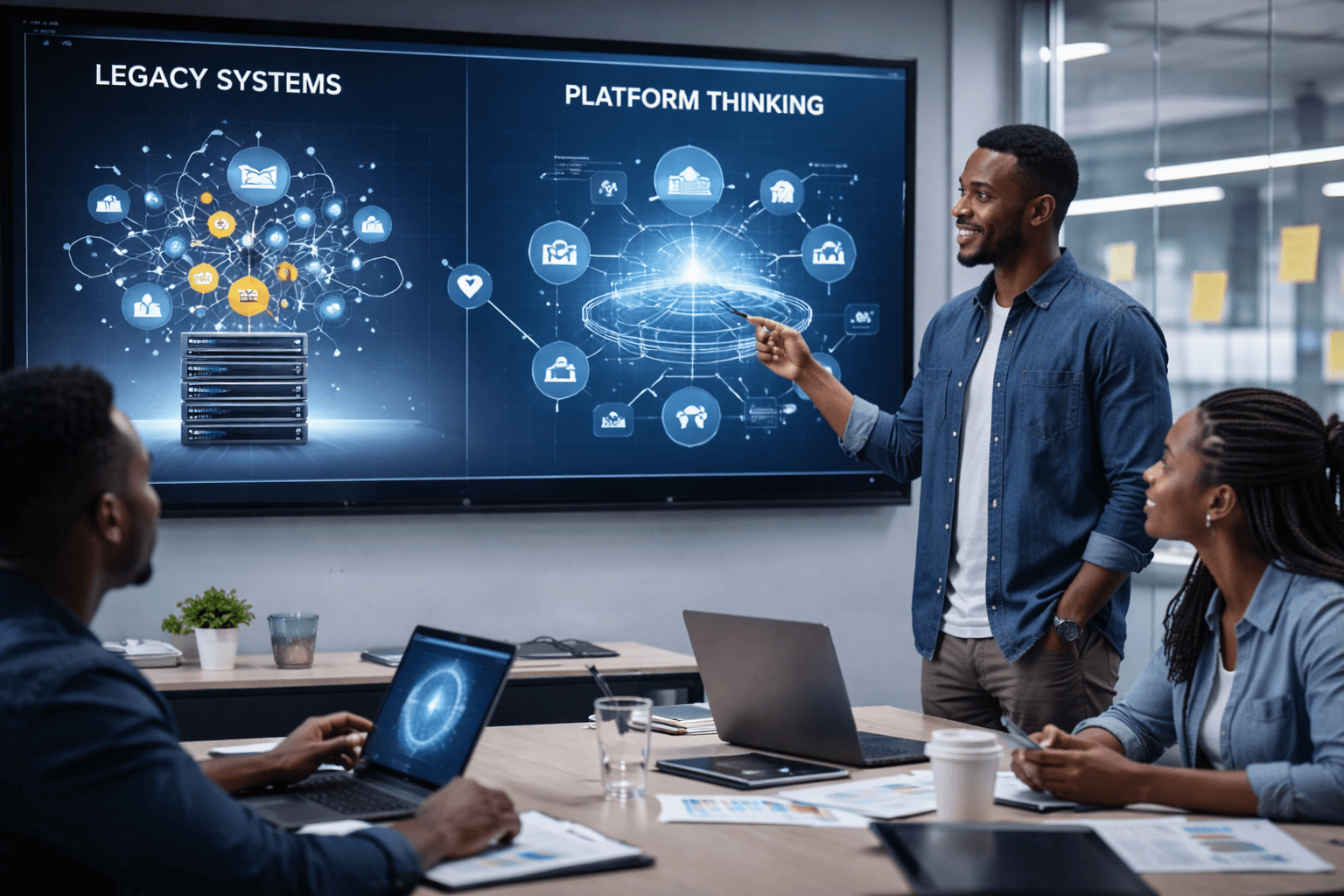
Many organizations know their legacy systems are slowing them down, but modernization efforts often fail because they treat migration as a technical replacement exercise. Real transformation is not about moving old tools to new infrastructure. It is about shifting from fragmented systems to platform thinking: a model where products, data, workflows, and teams operate as one scalable foundation for growth.
Many organizations know their legacy systems are slowing them down, but modernization efforts often fail because they treat migration as a technical replacement exercise. Real transformation is not about moving old tools to new infrastructure. It is about shifting from fragmented systems to platform thinking: a model where products, data, workflows, and teams operate as one scalable foundation for growth.
Legacy environments usually evolve through urgent fixes and departmental decisions. Over time, teams inherit disconnected tools, duplicate data, manual reconciliations, and brittle integrations. This creates hidden costs: slow reporting cycles, inconsistent customer experiences, security risks, and heavy dependency on a few internal experts. Businesses may still function, but they cannot adapt quickly.
Platform thinking starts with architecture tied to business capabilities, not org charts. Instead of building isolated systems for each team, organizations identify shared capabilities such as identity, payments, communication, analytics, and workflow orchestration. These become reusable services that multiple products can leverage. The result is faster delivery, lower maintenance overhead, and consistent governance across business units.
The move should be phased, not disruptive. A practical modernization model has four stages. First is discovery and mapping. Teams document critical workflows, system dependencies, data flows, and failure points. Second is stabilization. High-risk components are secured and monitored before any major migration begins. Third is modular transition. Priority capabilities are extracted into services or platform modules while legacy systems continue running. Fourth is optimization and scale, where teams improve performance, retire technical debt, and standardize delivery patterns.
Data strategy is central in this transition. Legacy systems often hold inconsistent records, conflicting identifiers, and weak ownership rules. Platform models require a clear source-of-truth approach, data contracts between services, and structured event logging. Without this, teams may modernize interfaces while preserving old data problems underneath. Platform success depends on both system design and data discipline.
Operating model change is equally important. Legacy organizations typically have project-based delivery: build once, hand over, move on. Platform organizations work with product ownership: measure continuously, improve continuously, and align roadmaps with business outcomes. Engineering, product, and operations teams need shared accountability for uptime, adoption, and value realization.
Governance should enable speed, not block it. Standardized APIs, security controls, release policies, and observability practices reduce risk while increasing development velocity. When every team follows common platform guardrails, integration becomes simpler and incidents become easier to diagnose. This is what separates scalable organizations from those that keep rewriting the same solutions.
Financially, platform thinking improves return on technology spend. Instead of paying repeatedly for overlapping systems, businesses invest once in reusable foundations and deploy new products faster. Time-to-market improves, support costs drop, and strategic initiatives stop getting delayed by infrastructure bottlenecks.
At GTECH, we guide businesses through this shift by combining architecture strategy with delivery execution. We help teams prioritize what to modernize first, how to reduce migration risk, and how to build a platform foundation that supports future products, not just current operations. The objective is not modernization for its own sake. The objective is resilience, speed, and long-term optionality.
Legacy systems are not just a technical issue; they are a growth constraint. Platform thinking removes that constraint by turning technology from a patchwork of tools into a strategic capability. Organizations that make this shift can respond faster, innovate confidently, and scale without rebuilding their core every time priorities change.